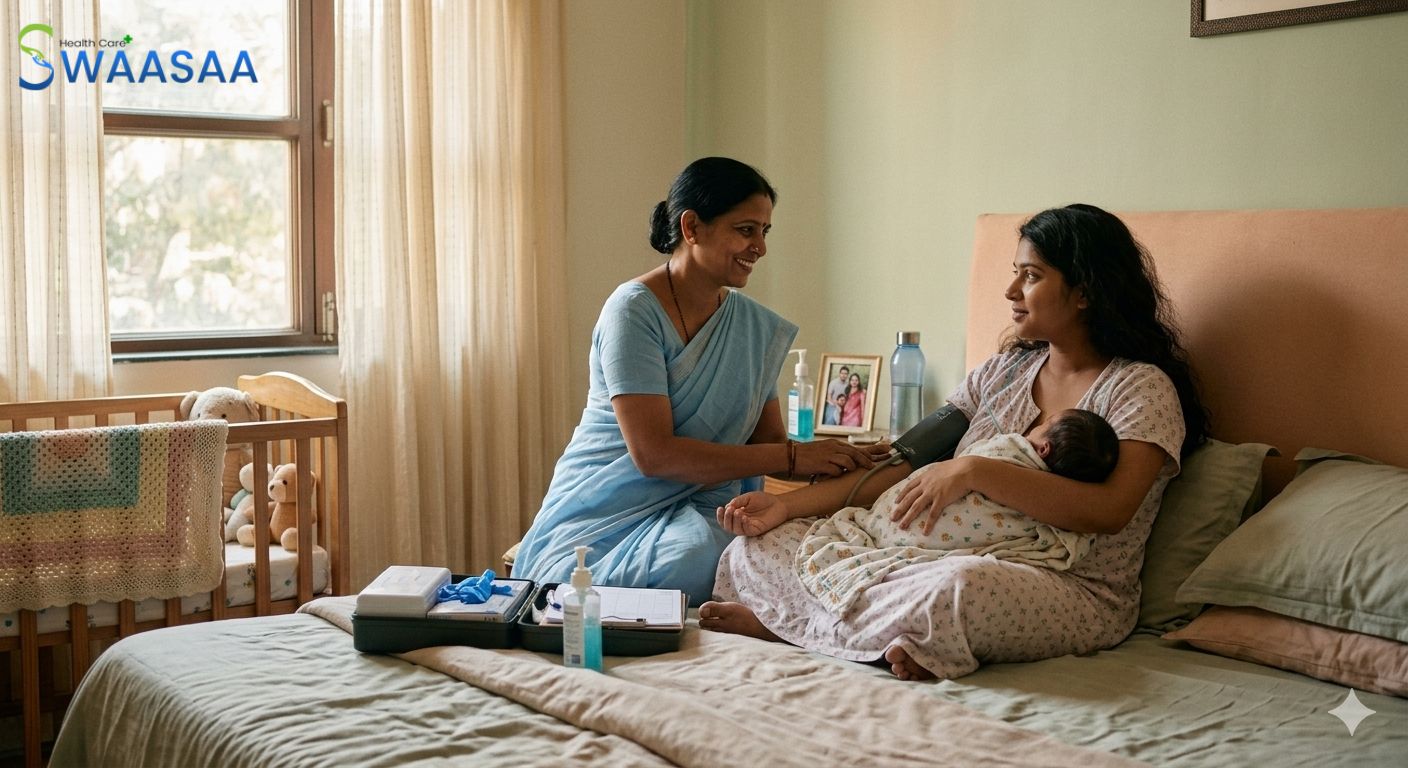
The transition from the clinical environment of a hospital to the sanctuary of your home can be a monumental shift. In the medical community, the first twelve weeks of life post-birth are commonly referred to as the Fourth Trimester. This time of life is not merely a “waiting phase” for the baby to grow; rather, it is a critical physiological and psychological bridge in which the groundwork for future health outcomes in both the mother and child are set.
At Swaasaa, we understand that professional home care in this time of life is not merely a “luxury”,it is a specialized health intervention. In the following pages, we will examine the technical requirements of a safe and scientifically-supported postpartum recovery for both the mother and child.
Mother’s Recovery: Moving Past “Getting Rest”
The postpartum period of time is a time of significant biological recalibration. A new mother’s body is in a state of profound hormonal withdrawal, uterine involution, and fluid shift.
Clinical Monitoring of Wounds and Vitally
For mothers who have undergone C-Sections and episiotomies, wound care is of primary importance. Professional home care for such mothers includes:
- Infection Surveillance: Localized heat, unusual discharge, and “dehiscence” (separation of wound edges) are monitored for infection.
- Postpartum Hemorrhage (PPH) Prevention: Lochia patterns are monitored to ensure adequate uterine contractions.
- Vitals Tracking: Sudden spikes in blood pressure can be a sign of postpartum preeclampsia, a condition that can occur up to six weeks postpartum.
The Role of Postnatal Nutrition
Metabolism in breastfeeding is higher than in pregnancy. A postpartum diet plan is developed to provide Galactagogues (milk production promoters) and anti-inflammatories such as Omega-3 fatty acids and Iron to combat the effects of physiological depletion caused by childbirth.
Newborn Care: The First 28 Days (Neonatal Phase)
- The neonatal period is considered the most vulnerable period of the human lifespan.
- A newborn’s systems are ‘learning’ to function outside the womb.
Thermoregulation and Skin Integrity
Newborns have a high surface area to volume ratio. Professional caregivers must attend to the following needs of the newborns:
- Kangaroo Mother Care (KMC): Making use of skin-to-skin contact to regulate the heart rate of the newborn.
- The Umbilical Stump: Dry Cord Care is the present global gold standard for the prevention of neonatal sepsis.
Establishing the Lactation Cycle
Breastfeeding is a biological process but requires a learned skill. A professional caregiver assists in correcting the “latch,” ensuring the mother does not suffer from nipple trauma and the infant receives the “hindmilk” instead of the “foremilk,” which is only useful for quenching the baby’s thirst.
Addressing the Mental Landscape: Postpartum Mood Disorders
There is a clinical distinction between the “Baby Blues” and Postpartum Depression (PPD). The Baby Blues is a short-term side effect of hormonal changes. PPD is a serious mental health disorder requiring treatment.
A trained home caregiver is the “first responder” for mental health disorders by:
- Identifying the signs of withdrawal or extreme anxiety.
- Relieving the mother of the mental and physical burden of household work and baby hygiene. She is free to spend time bonding with the baby and sleeping—the two best non-pharmacological interventions for PPD.
Why Professional Home Care is Essential in 2026
Today’s family structures are often nuclear in nature, lacking the support systems that were in place in earlier eras. However, today’s healthcare system in 2026 is far too intricate to rely solely on advice given to a new family.
Professional home care offers:
- Consistency: Unlike a hospital setting where shifts are constantly changing, a home health care worker knows your family’s unique schedule.
- Sterile Environment: Home health care can significantly reduce a newborn’s risk of acquiring a hospital-borne infection (also known as a “nosocomial” infection).
- Customized Education: Parents are taught proper handling techniques, diapering, and soothing in the comfort of their own home, greatly increasing parental confidence.
Summary: A Partnership in Growth
The objective of postnatal and baby care is to achieve a “state of thriving” instead of “survival.” This is made possible by combining professional expertise and loving at-home care so that the Fourth Trimester is a time of rejuvenation instead of exhaustion.
Investing in professional postnatal and baby care at this critical time is an investment in the health of two generations: a healthy mother restored to full strength and a healthy baby born in a safe and hygienic environment.
Popular Posts
Symptoms of COVID-19





Elderly Care Tips at Home
Postnatal Care: A Guide to the “Fourth Trimester
Renting Medical Equipment for home care